
Las Cruces City Directory Collections
Las Cruces has confirmed historical resources, but no official web page found for this research gives a verified year-by-year shelf list for local city directories or reverse directories. That gap matters. A library or archive may hold a directory volume without publishing its run online, and an unfamiliar title may be alphabetical rather than arranged by street. The confirmed collections below are useful for directory research because they establish a place, a date, or a local source. They are not evidence that a particular person or address appears in every year.
| Collection | Years | Where Held | Access |
|---|---|---|---|
| Digital Sanborn Maps New Mexico | 1867-1970 | Thomas Branigan Memorial Library research resources | Library research resource; confirm current access |
| Amador Family Papers correspondence | 1861 into the 1940s | NMSU Archives and Special Collections | Finding aid and digitized material; not every item is online |
| Amador trade catalogs | 1873-1942 | NMSU Archives and Special Collections | Collection and finding-aid research |
| State Archives county holdings | Generally 1850-1912 | New Mexico State Archives | Heritage Search finding aid, request specific material |
| Las Cruces city or reverse directory volumes | Not verified | Confirm with Thomas Branigan or NMSU | Ask for title, call number, format, and restrictions |
Before treating a printed volume as a Las Cruces city directory, ask staff to confirm the title, coverage year, call number, and whether it is alphabetical or criss-cross, meaning street-order. The direct browse link and digitized year run remain a research gap, not a reason to fill the table with guesses.
- 1861: Amador correspondence begins its documented span into the 1940s.
- 1867: The library’s named Digital Sanborn Maps New Mexico coverage begins.
- 1873: The Amador trade-catalog coverage begins.
- 1912: State Archives county holdings generally reach this endpoint.
- 1942: The documented Amador trade-catalog coverage ends.
- 1970: The library’s named Digital Sanborn coverage ends.
Note: Record the repository and exact volume before copying an entry into a family or place-research log.
Las Cruces City Directory Requests
Thomas Branigan Memorial Library is the municipal hub for local reference work. Its research resources name Ancestry Library Edition for in-library use, Chronicling America, FamilySearch, HeritageQuest, Digital Sanborn Maps New Mexico, historical New Mexico newspapers, New Mexico Collection materials, and Las Cruces Sun-News coverage from 2021 forward. Those sources can narrow a date or spell a surname before a request is made. A subscription named by the library may require use on a library connection, so availability should be confirmed at the time of the visit.
A productive question is narrow: ask whether a confirmed year has a Las Cruces directory, whether the volume is alphabetic or street order, and whether copying or scanning is allowed. NMSU staff can work from surname variants, a street or block, a date window, and a collection or finding-aid citation. For State Archives material, provide Doña Ana County, record series, date range, and any Heritage Search identifier. That approach asks staff to locate a known record path, not to assemble a list of people at an address.
The Thomas Branigan Memorial Library image shows the municipal library source behind a Las Cruces city directory inquiry.
Use the library’s current contact route to verify a volume and its access conditions before treating it as an available directory shelf.
Las Cruces City Directory Source Checks
Historical newspapers are a cross-check, not a substitute for a city directory. Search a street, block, business, church, school, road, or surname with alternate spellings. A newspaper can fix a date, describe an event, or reveal the words used for a place. It can also contain editorial or typographical error. Sanborn maps have a separate role: they help explain the built environment and block changes, but they do not establish a current resident or present-day address.
When a volume is confirmed, compare the entry’s publication date with a period map and a newspaper search. The result may support a time-and-place question, such as whether a business was described at a location during that period. It does not turn an old listing into current address evidence. For current address-keyed work, use the records path in the Las Cruces by-street directory after the historical source has supplied the relevant time window.
The Las Cruces Library reference sources image captures the kind of genealogy and local-history resources that should be checked alongside a directory request.
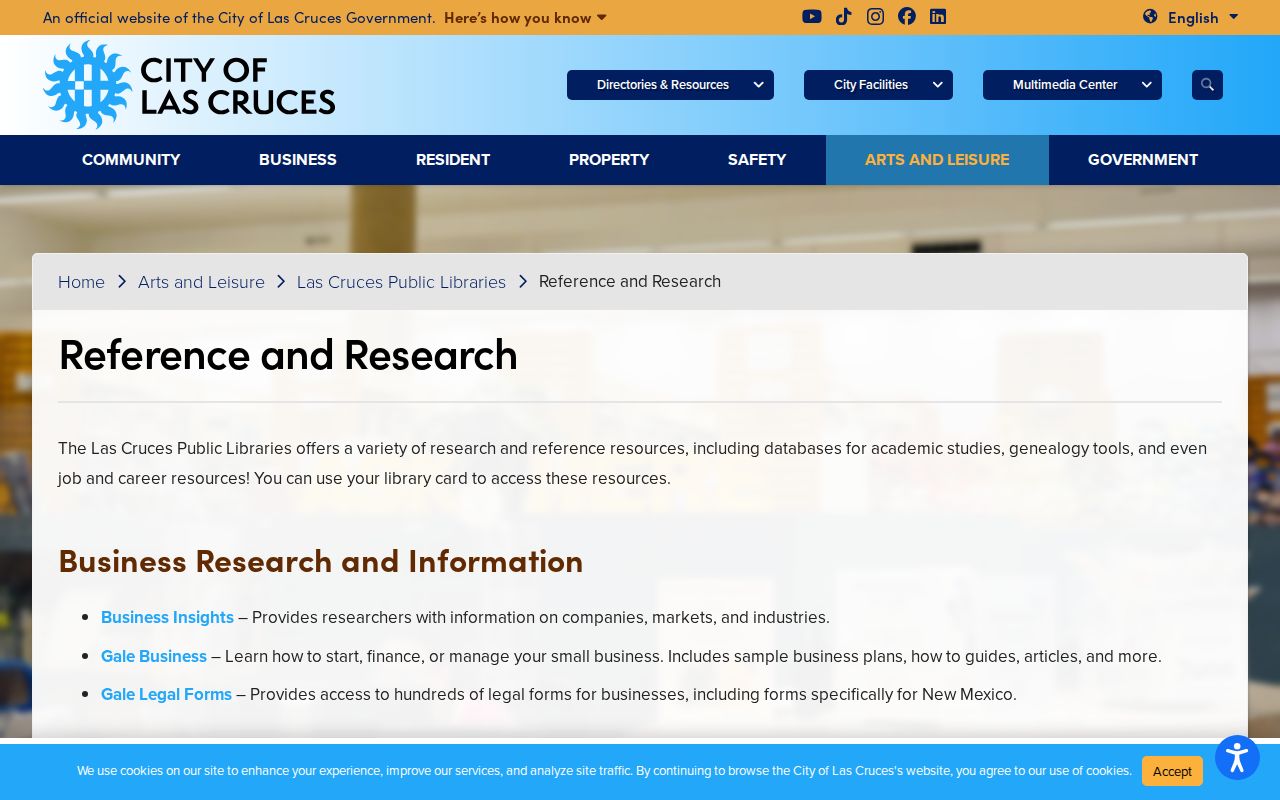
The named sources help build a search vocabulary, then the repository confirms whether a particular city directory exists and can be consulted.
Las Cruces City Directory Context
NMSU Archives and Special Collections adds a deep primary-source layer. Its research room is in Branson Hall, fourth floor east, on the main campus. Published contact details include archives@lib.nmsu.edu, 575-646-3839, research-room hours Monday through Friday from 9 to 4, and information hours from 1 to 4 or by appointment. Check current hours before travel. A finding aid should come first because a collection description does not mean every item is digitized or available without notice.
The Amador Family Papers are especially valuable when a city directory lead needs local context. The collection includes more than 16,000 pages of digitized correspondence from 1861 into the 1940s, more than 1,300 searchable digitized images, Las Cruces-area scenes, business records, advertisements, trade catalogs from 1873 to 1942, printed ephemera, and regional newspapers. A merchant letterhead, catalog, photograph caption, or advertisement can connect a street or business name to a period. It still needs a citation that states exactly what the item shows.
The NMSU Amador Family Papers image leads to a collection that can enrich a Las Cruces city directory trail with locally dated primary material.
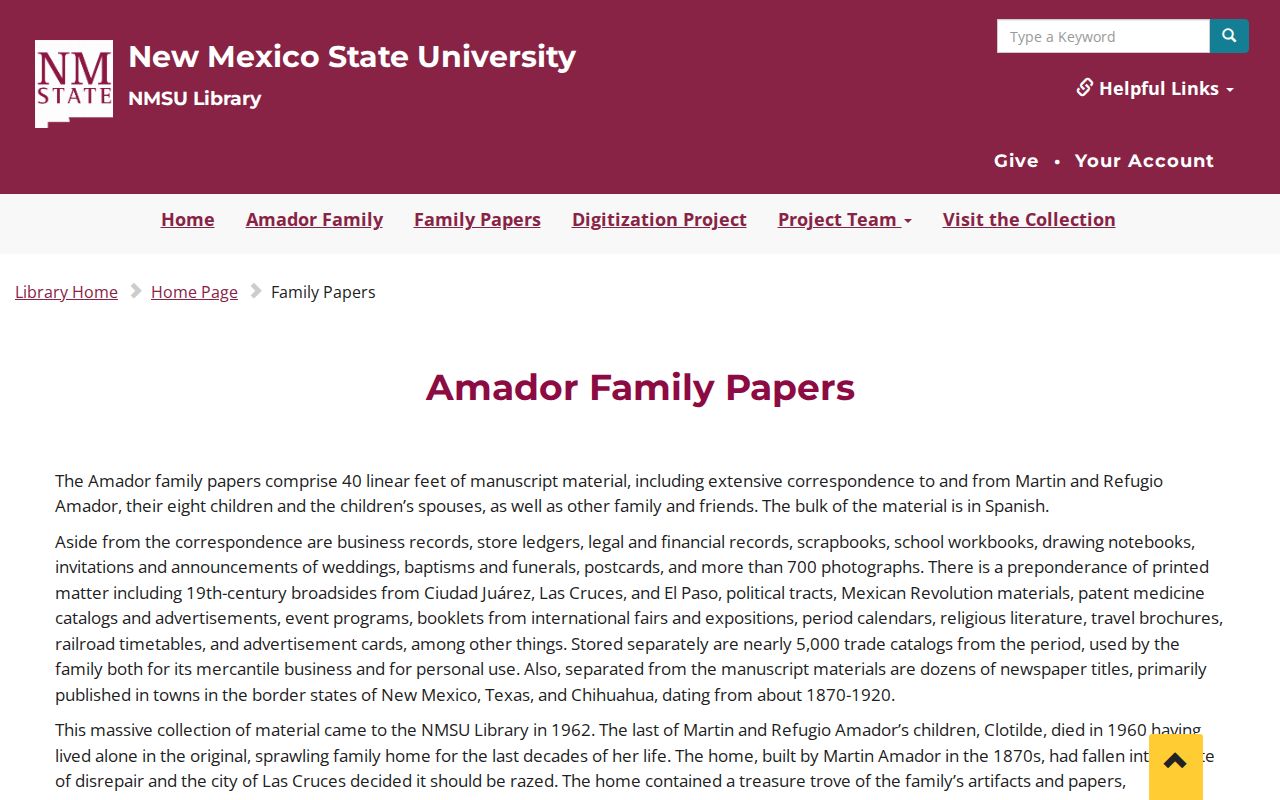
Capture the collection title, finding-aid reference, item date, and a neutral description of the evidence rather than inferring more than the item supports.
Reading a Las Cruces City Directory
No confirmed Las Cruces directory volume was opened in this research, so its actual entry layout, symbols, and fields must not be claimed. If Thomas Branigan or NMSU confirms a volume, first photograph or transcribe its title page, publication year, and abbreviation key. Then record only the fields that volume actually displays. The inventory below is a worksheet for documenting a confirmed entry, not a statement that every local directory contained each field.
| Name as printed | Preserve initials, spelling, and any suffix exactly as the confirmed volume shows them. |
|---|---|
| Address or street reference | Record the complete text and compare it with the period map rather than silently modernizing it. |
| Business text | Copy only if present, with the original wording and page reference. |
| Household or relationship notation | Transcribe only a notation actually printed in the confirmed volume. |
| Abbreviation or symbol | Save the volume’s own key and page so later readers can interpret the mark. |
- Criss-cross directory
- A directory arranged by street or address order, if the repository confirms that format for a particular volume.
- Householder index
- An index that identifies a household reference when a confirmed directory supplies one; its contents vary by volume.
- Abbreviation key
- The printed explanation of shortened terms or symbols in a volume. Preserve it before interpreting an entry.
Separate a direct reading from an inference. “The entry prints this street text” is different from “the entry may refer to a later parcel.” That distinction keeps a historical city directory useful when streets, parcel lines, and numbering have changed.
Las Cruces City Directory Crosschecks
Digital Sanborn Maps New Mexico has named coverage from 1867 through 1970. That long range makes it useful for a block-history check around a confirmed directory year. Look for roads, structures, and block changes, then describe the map label as a map label. A Sanborn sheet is not a current occupancy record, and collection coverage does not mean a map exists for every address in every year.
Pair a map search with historical newspapers and keep the date window visible. Alternate spellings can matter. So can a business, church, school, road, or block name that a later address no longer uses. A careful searcher compares the name, place, date, and spelling across sources rather than accepting one match as conclusive.
Las Cruces City Directory Place Clue
Las Cruces history preserves one concrete continuity clue: Depot Street is today’s Las Cruces Avenue. That makes an old reference to Depot Street worth searching under both names when the time period fits. It does not prove that every house number or property line carried forward unchanged. The research did not locate an authoritative citywide street-renumbering chronology, so any claim of a renumbered address must be confirmed with the City historic-preservation office, Thomas Branigan staff, or NMSU Archives.
There is a second records-geography clue. Mesilla was the county seat when Doña Ana County formed in 1852, while current county offices are in Las Cruces. Follow the date and custodian for older county material instead of assuming modern office location identifies the right historical source.
The Las Cruces Crossroads of History image is the source for the Depot Street and Las Cruces Avenue historical connection.
Use this as a search-variant clue, then verify the historical street and parcel relationship with period sources and the responsible records office.
Tracing Las Cruces City Directory Leads
A household trail is strongest when it moves from the most stable place information outward. Normalize the modern address with USPS, retain the exact street variants, locate the parcel and legal description in EagleWeb or County GIS, and note any assessor transfer leads for later Clerk verification. Then search library newspapers and Sanborn resources by street, block, and date. Finally, use an archive finding aid to request the item that matches the known place and time.
- Write down the surname variants, street or block, and a narrow date window.
- Ask Thomas Branigan or NMSU to confirm a city directory volume, its order, and its citation details.
- Record the confirmed entry exactly, including page, abbreviations, and publication date.
- Compare the entry with a period newspaper or Sanborn map without treating either as present-day evidence.
- Use parcel and recording identifiers only when a property question requires a modern records handoff.
A name disappearing from a historical source has several possible explanations: a move, a spelling change, a changed address form, an unlisted household, or a gap in available material. Mark the gap rather than assigning a reason. The record trail supports family and place research when each source is kept in its own time and scope.
Note: Preserve the source URL, access date, exact search term, and any repository restriction with every historical note.
Las Cruces City Directory Archive Requests
New Mexico State Archives adds Spanish-era, Mexican-era, and Territorial material through Heritage Search, a cross-repository finding aid. Its county records generally cover 1850 through 1912. Search the finding aid by place, family, business, or road name, then request a specific box, folder, or item. A finding-aid description is not a document image. Confirm access status and citation details before planning a visit or remote request.
The archive’s genealogy guidance points toward church records, census material, and published family histories. These sources can test a time-and-place hypothesis from a confirmed city directory. They cannot fill a missing directory run or substitute for a record that was never located. The State Archives lists its Santa Fe research location at 1205 Camino Carlos Rey and public hours Monday through Friday, 10 a.m. to 4:45 p.m.; appointments and remote guidance have their own posted hours.
The NMSU Archives and Special Collections contact page image documents a local route for confirming access before a Las Cruces city directory or related collection request.
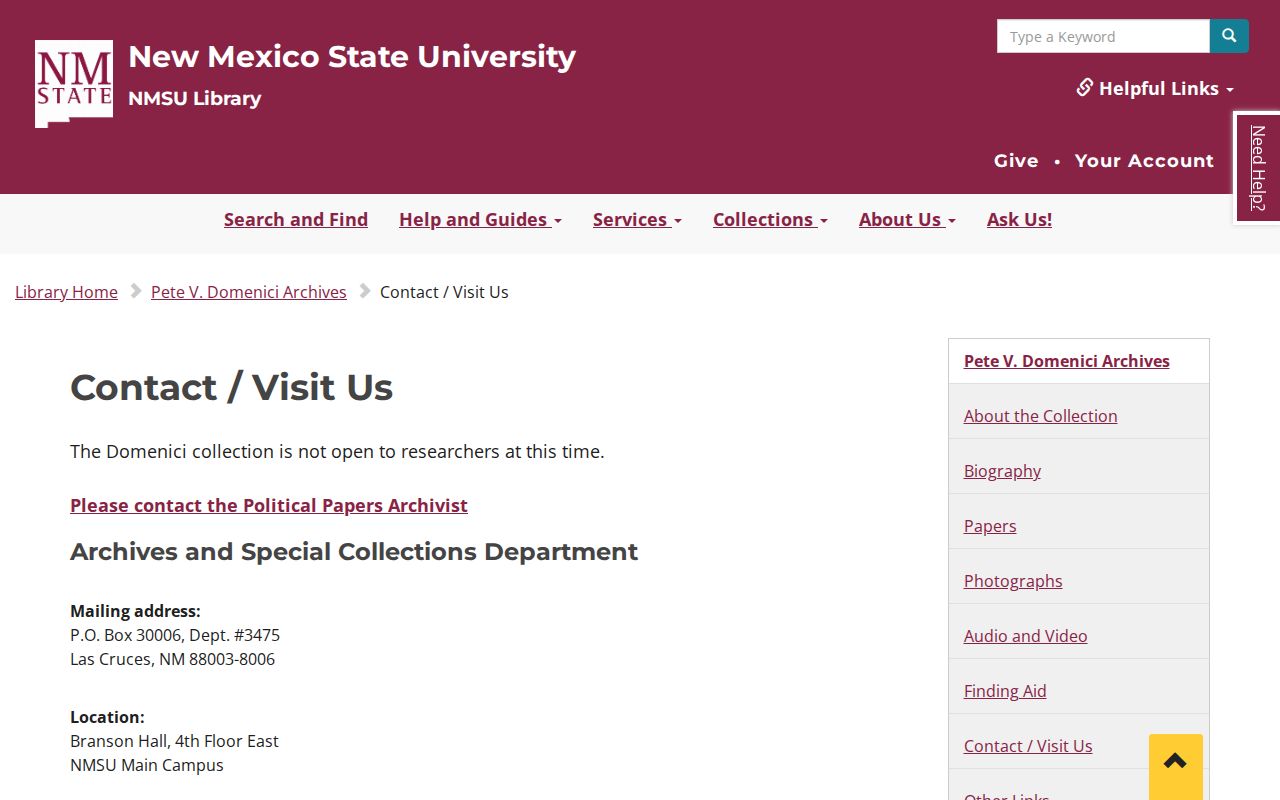
A requested item is easier to locate when the message includes the collection name, date window, place reference, and any known finding-aid identifier.
Confirming a Las Cruces Directory Lead
Historical work needs a clear citation trail. Keep the source title, repository, collection, box or folder or stable link, item date, access date, and a neutral statement of what the item supports. A photograph may show a local scene; a catalog may show a business; a directory entry may show text on one printed page. None should be stretched into a full chronology of a private life.
When a record points toward a current legal parcel or recorded instrument, preserve the parcel number, account number, reception number, or other stable identifier first. County GIS, an assessor account, a City action, and a Clerk recording can update on different schedules. The most useful conclusion is often the next custodian and the specific document to request.